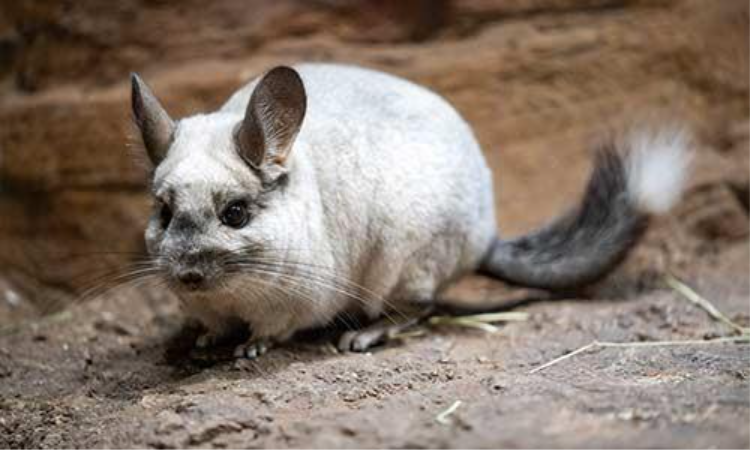
Chinchillas are crepuscular, agile, and use fur slip and alarm calls to evade predators. They feed on dried vegetation and sleep during the day.
Animal Behavior
Feeding Habits
Chinchillas are herbivorous generalists, meaning
they consume a wide variety of plant materials depending on seasonal
availability. In the wild, they primarily eat shrub leaves, herbs,
grasses, and occasionally dried plant matter. Their diet is
rich in fiber, which helps maintain their sensitive digestive systems.
Chinchillas prefer dead and dried leaves over fresh ones and
rarely consume seeds or pods.
Defense Mechanisms
Despite their small size, chinchillas have evolved several
clever ways to protect themselves from predators:
- Fur
Slip: When grabbed or threatened, chinchillas can release a patch
of fur to escape a predator�s grip.
- Speed
and Agility: They are fast runners and excellent jumpers, capable
of leaping up to 6 feet to evade danger.
- Burrowing
and Hiding: Chinchillas live in rocky crevices and burrows, which
offer protection from aerial and ground predators.
- Camouflage: Their
grayish fur blends well with the rocky terrain of the Andes Mountains.
- Alarm
Calls: They use high-pitched squeals to alert others in their
colony of nearby threats.
- Group
Living: Wild chinchillas often live in colonies of up to 100
individuals, enhancing their collective defense
Sleeping Habits
Chinchillas are crepuscular, meaning they are
most active during dawn and dusk. They sleep for 10�12
hours during the day, often curled up in tight, enclosed spaces like nest
boxes or hammocks. While sleeping, their ears droop downward, and they may rest
on all fours, their side, or even their back. Occasionally, chinchillas sleep
with their eyes open, which is normal and not a cause for concern.
🐭 Chinchilla Life: From
Mountain Hoppers to Fluffy Roommates
🌍 Migration Patterns
Wild chinchillas are native to the Andes Mountains in
South America, particularly in Chile. They don�t migrate in the
traditional sense like birds or caribou. Instead, they live in rocky, arid
regions at high altitudes and stay within a relatively small territory.
Their �migration� is more like daily hopping around to find food,
shelter, and dust bath spots. In captivity, their biggest migration is from the
food bowl to the hammock.
🏡 Lifestyle
Chinchillas are:
- Nocturnal:
Most active at night and during twilight hours.
- Burrowers
and climbers: In the wild, they live in crevices or burrows to stay
safe from predators and extreme temperatures.
- Dust
bath lovers: Instead of water, they roll in volcanic ash or fine dust
to keep their fur clean and oil-free.
In captivity, they need:
- A multi-level
cage for climbing
- Dust
baths several times a week
- Chew
toys to keep their ever-growing teeth in check
👨👩👧👦
Social Behavior
Chinchillas are social animals and often live in colonies
in the wild, sometimes with dozens of individuals. They communicate through:
- Squeaks
- Barks
- Tail
flicks
- The
occasional dramatic popcorn jump
In captivity, they can live alone if given lots of
attention, but they generally do better in pairs or small groups�preferably
same-sex unless you want a surprise chinchilla nursery. They do not communicate with other species.
⏳ Lifespan
- Wild
chinchillas: 8�10 years (due to predators and harsh conditions)
- Pet
chinchillas: 10�20 years with proper care (some even reach 22!)
That�s a long time for a fluffball the size of a potato!
Interesting Facts
- Chinchillas
have the densest fur of any land mammal, with over 20,000
hairs per square centimeter, making them nearly immune to parasites
like fleas.
- They take
dust baths instead of water baths to clean their fur and prevent
matting.
- Chinchillas
can live up to 20 years in captivity, though their lifespan in
the wild is typically 8�10 years.
- They
are endangered due to habitat loss and overhunting for
their fur.
- Chinchillas are social animals and often form strong bonds with their owners when kept as pets
Anatomy and Biology
Size and Weight
The long-tailed chinchilla (Chinchilla lanigera) is a small rodent with the following physical
dimensions:
- Body
Length: 8.5�14 inches (22�36 cm)
- Height: 4.1�6.9
inches (10.5�17.5 cm)
- Tail
Length: 3�6 inches (8�15 cm)
- Weight: 1.8�2.4
pounds (800�1100 g) in captivity; wild males average 412 g and females 422
g
Lifespan
Chinchillas have a relatively long lifespan for rodents:
- In
the Wild: 8�10 years
- In
Captivity: 10�20 years, with some individuals living over 22
years
Respiration
As mammals, chinchillas breathe through lungs.
Air enters through the nose or mouth, travels down the trachea, and into the
lungs where oxygen is exchanged for carbon dioxide. Their respiratory system is
adapted to high-altitude environments, allowing efficient oxygen uptake in the
thin air of the Andes Mountains
Unique Physical Characteristics
Chinchillas possess several remarkable anatomical features:
- Fur
Density: They have the densest fur of any land mammal, with up
to 75 hairs growing from a single follicle. This makes their
coat extremely soft and insulating, ideal for cold climates.
- Coloration: Wild
chinchillas are typically bluish-gray, but
domesticated varieties come in colors like beige, white, ebony, violet,
and sapphire due to selective breeding.
- Eyes
and Vision: They have large black eyes with vertical
slit pupils, enhancing their vision in low light.
- Ears
and Temperature Regulation: Their large ears help
regulate body temperature, as chinchillas cannot sweat.
- Limbs
and Mobility: Hind legs are longer than forelegs, giving them
excellent jumping ability. They can leap up to 6 feet.
- Whiskers
(Vibrissae): Long and sensitive, used for spatial awareness in
dark environments.
- Feet: They
have fleshy foot pads and four digits on
each foot, surrounded by stiff bristles for traction and grooming